Attending the CHI2026 International Academic Conference @Barcelona

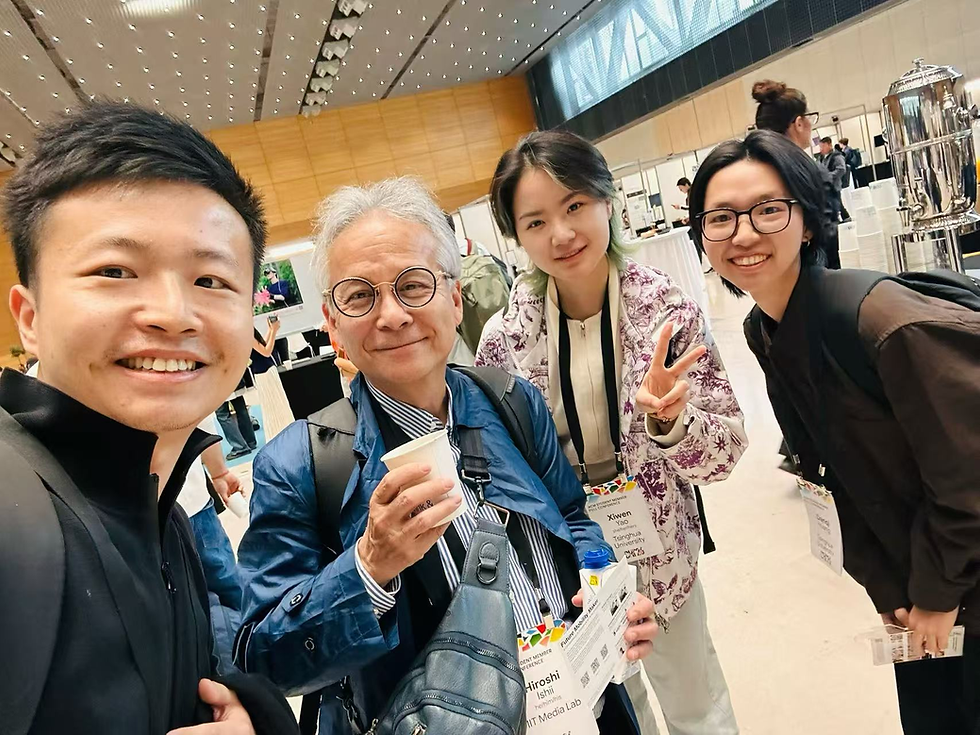
In mid-April 2026, the students of Milab traveled to Barcelona, Spain, to attend the renowned ACM CHI Conference on Human Factors in Computing Systems (CHI 2026). The conference was held from April 13th to April 17th and is one of the premier international events in the field of human-computer interaction. At the conference, Milab presented a large number of works and showcased their latest research findings.
The paper, Designing for Long-Term Emotion Regulation: A Breathing Biofeedback Game for Women in Compulsory Isolation Drug Rehabilitation Centers, was authored by Qi Chen.The study focuses on the challenges of emotion regulation during women’s drug rehabilitation, where difficulties in regulating emotions are considered a major risk factor for relapse. At the same time, shame, low self-esteem, and impaired cognitive functioning may further undermine individuals’ ability to learn and consistently apply emotion regulation skills.To address the limited research on the long-term transfer of such skills among populations living in closed rehabilitation environments, the study designed and evaluated a seven-day staged breathing biofeedback game based on low-cost audio input. The game was developed to support the acquisition and transfer of emotion regulation skills, enhance participants’ self-efficacy and self-acceptance, and promote sustained attention and long-term engagement.A six-week controlled study involving 60 participants showed that the game not only maintained a high level of engagement, but also effectively improved participants’ breathing regulation skills, facilitated the transfer of these skills into everyday life, and alleviated negative emotions.Based on the findings, the study further proposed five design implications for supporting long-term emotion regulation and skill transfer in rehabilitation settings.Notably, the paper received the CHI 2026 Best Paper Award.

The title of the paper is "AI-generated AR Reassembly Guidance from Disassembly Videos to Scaffold Everyday Repair". The author is Deng Wenjing. This study proposes RePairAR, exploring how to utilize multimodal large language models to convert disassembly videos into reassembly guidance that can be presented in augmented reality (AR), thereby generating usable AR maintenance guides without relying on specific product instructions or 3D models. Its core objective is to provide users with understandable and followable support, reducing the entry barrier for daily household maintenance. Additionally, RePairAR represents a change in the way maintenance knowledge is generated, reorganizing previously relatively closed and mainly held by manufacturers or experts into practical resources that users can generate, call upon, and master based on their own operational processes. This study hopes to promote more discussions on "daily maintenance and extending product lifespan" and support more sustainable usage and consumption behaviors.

The title of the paper is "GestuProp: 3D Virtual Reality Prop Generation with Co-Speech Gestures", and the authors are Yao Zhihao, Yao Xiwen, and others. This study proposes GestuProp, exploring how to utilize the collaborative expression of gestures and language to enable users to directly generate 3D props in a virtual reality environment. The core objective is to convert users' natural body expressions into spatial and semantic constraints that generative AI can understand, allowing users to complete virtual object creation simply by grasping, gesturing, and describing with language without needing to master complex 3D modeling tools. The research further discovers that gestures mainly carry spatial information such as size, shape, direction, and holding relationship, while language supplements object categories, appearance, and functions. Together, they form a more natural generative interaction method. GestuProp also reflects the change in 3D content creation methods, enabling generative AI to move beyond relying on text prompts and enter a more embodied interaction process, allowing users to directly utilize their body experience to express and explore creative intentions. This study aims to promote more discussions on embodied generation, immersive content creation, and human-machine collaborative creation, and provide new possibilities for real-time 3D content generation in VR games, social spaces, and design communication.

The title of the paper is "DuoMorph: Synergistic Integration of FDM Printing and Pneumatic Actuation for Shape-Changing Interfaces". The first author is Li Xueqing. The research proposes DuoMorph, which integrates FDM printing with pneumatic drive. It completes heat sealing and 3D/4D printing through an integrated ordinary 3D printer, achieving a flexible and deformable interactive interface with driving, constraining and functional expansion capabilities.



Xiwen Yao, Danqi Huang, Beituo Liu, Haipeng Mi, and Zhihao Yao. 2026. Drawing with Space: Understanding Creative Practice in AI-Supported Projection Mapping. In Proceedings of the Extended Abstracts of the 2026 CHI Conference on Human Factors in Computing Systems (CHI EA '26). Association for Computing Machinery, New York, NY, USA, Article 243, 1–6. https://doi.org/10.1145/3772363.3799084
Qi Chen, Jiachen Du, Zhihao Yao, Michael Detsiang Li Jr, Haoran Liu, Yu Cheng, Yijie Guo, Yanzhi Yang, XiJing Chen, and Haipeng Mi. 2026. Designing for Long-Term Emotion Regulation: A Breathing Biofeedback Game for Women in Compulsory Isolation Drug Rehabilitation Centers. In Proceedings of the 2026 CHI Conference on Human Factors in Computing Systems (CHI '26). Association for Computing Machinery, New York, NY, USA, Article 1106, 1–26. https://doi.org/10.1145/3772318.3790574
Xueqing Li, Danqi Huang, Tianyu Yu, Shuzi Yin, Bingjie Gao, Anna Matsumoto, Zhihao Yao, Yiwei Zhao, Shiqing Lyu, Yuchen Tian, Lining Yao, Haipeng Mi, and Qiuyu Lu. 2026. DuoMorph: Synergistic Integration of FDM Printing and Pneumatic Actuation for Shape-Changing Interfaces. In Proceedings of the 2026 CHI Conference on Human Factors in Computing Systems (CHI '26). Association for Computing Machinery, New York, NY, USA, Article 1362, 1–14. https://doi.org/10.1145/3772318.3791040
Xiwen Yao, Danqi Huang, Beituo Liu, Haipeng Mi, and Zhihao Yao. 2026. Drawing with Space: Understanding Creative Practice in AI-Supported Projection Mapping. In Proceedings of the Extended Abstracts of the 2026 CHI Conference on Human Factors in Computing Systems (CHI EA '26). Association for Computing Machinery, New York, NY, USA, Article 243, 1–6. https://doi.org/10.1145/3772363.3799084
Xuezhu Wang, Yao Lu, Xiwen Yao, Yifan Han, Zhihao Yao, and Haipeng Mi. 2026. How Does It Know?: Characterizing Thinking Through Unconscious Pen Gestures. In Proceedings of the Extended Abstracts of the 2026 CHI Conference on Human Factors in Computing Systems (CHI EA '26). Association for Computing Machinery, New York, NY, USA, Article 373, 1–5. https://doi.org/10.1145/3772363.3799074
Beituo Liu, Zhihao Yao, Yao Lu, Xuezhu Wang, Xiwen Yao, and Haipeng Mi. 2026. 3D Printing as Material Probe: Supporting Fiber Understanding in Papermaking Craft. In Proceedings of the Extended Abstracts of the 2026 CHI Conference on Human Factors in Computing Systems (CHI EA '26). Association for Computing Machinery, New York, NY, USA, Article 41, 1–4. https://doi.org/10.1145/3772363.3798951
Wenjing Deng, Zhihao Yao, Xinhui Kang, Qirui Sun, Xintong Wu, Sisi He, Chenzhuo Xiang, and Haipeng Mi. 2026. AI-generated AR Reassembly Guidance from Disassembly Videos to Scaffold Everyday Repair. Proceedings of the 2026 CHI Conference on Human Factors in Computing Systems. Association for Computing Machinery, New York, NY, USA, Article 1020, 1–16. https://doi.org/10.1145/3772318.3790494
Bingjie Gao, Shuzi Yin, Jiachen Du, Xinheng Song, and Haipeng Mi. 2026. Fix or Fake? How Creators Negotiate Cultural Bias in Generative AI Heritage Creation. In Proceedings of the Extended Abstracts of the 2026 CHI Conference on Human Factors in Computing Systems (CHI EA '26). Association for Computing Machinery, New York, NY, USA, Article 300, 1–5. https://doi.org/10.1145/3772363.3798340
Xinheng Song, Bingjie Gao, Zhaolin Lu, Qijun Gao, Wenting Li, Linci Xu, and Haipeng Mi. 2026. GenAI EmoJellyfish: Investigating the Synergistic Effects of Multi-modal Interaction on Emotion Regulation. In Proceedings of the Extended Abstracts of the 2026 CHI Conference on Human Factors in Computing Systems (CHI EA '26). Association for Computing Machinery, New York, NY, USA, Article 342, 1–7. https://doi.org/10.1145/3772363.3798459


Comments